Questionnaire or Interview?
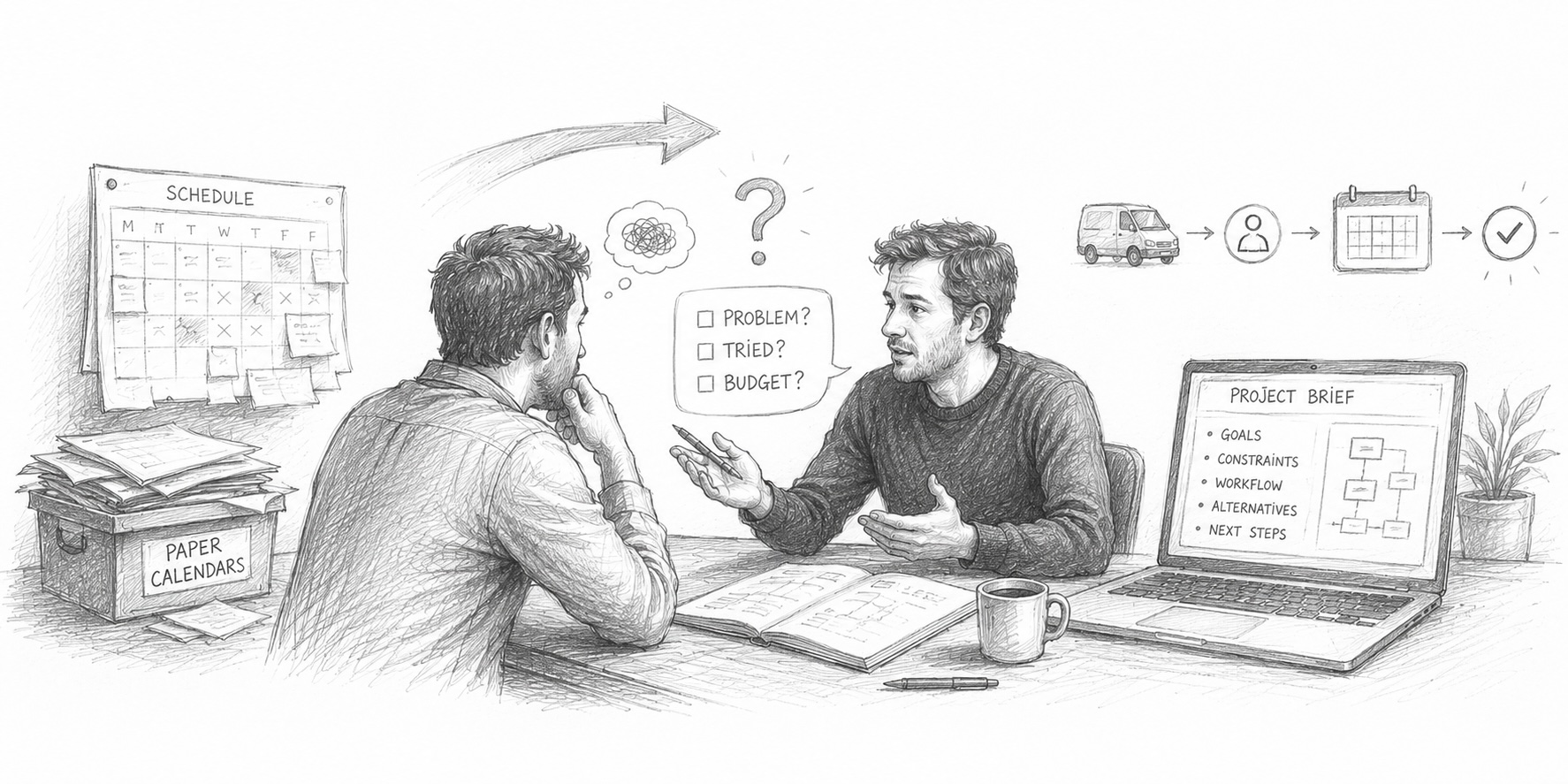
A small plumbing company once asked me to replace its paper scheduling calendar with digital calendars. We set them up using the systems already in place.
Technically, they worked. In practice, nobody used them.
We had solved the visible problem without understanding the workflow behind it. Who maintained the paper calendar? How did the workers use it? What additional effort could we reasonably expect from them?
I didn’t ask those questions. I heard “We need digital calendars,” so digital calendars were what we built.
That’s a common trap in client work. Identifying a problem is often easy; finding a solution that fits the existing workflow is harder. What a client asks for is not necessarily what they need.
The goal of discovery isn’t to find some objectively correct solution. It’s to uncover assumptions, constraints, and overlooked alternatives before building the wrong thing.
A questionnaire can help:
- What problem are you trying to solve?
- What have you already tried?
- What is your budget?
The problem isn’t the questions. It’s their inflexibility.
Even a branching questionnaire can only follow paths its author anticipated. If a client already has a solution in mind, their answers will often remain anchored to it. You may learn what they think they want without discovering what would actually work.
That’s why I prefer interviewing clients. A conversation lets me clarify ambiguity, challenge assumptions, and ask follow-up questions based on what I’ve just heard.
But this creates a trade-off:
- A questionnaire is asynchronous but rigid.
- An interview is flexible but must be scheduled.
I built Interview as an experiment in combining the two. It conducts an asynchronous conversation, asks follow-up questions based on the client’s answers, and turns the result into a project brief.
The initial framing still matters. It should define the project without steering the client toward a particular solution or accepting their assumptions too readily. And I still review the result myself. Tools like this can improve the first round of discovery, but they shouldn’t decide what gets built.
If you’ve tried LLM-assisted interviews (using Interview or another approach), I’d be interested to hear what worked and what didn’t. Send me an email or message me on 𝕏.