What Actually Is an AI Agent?
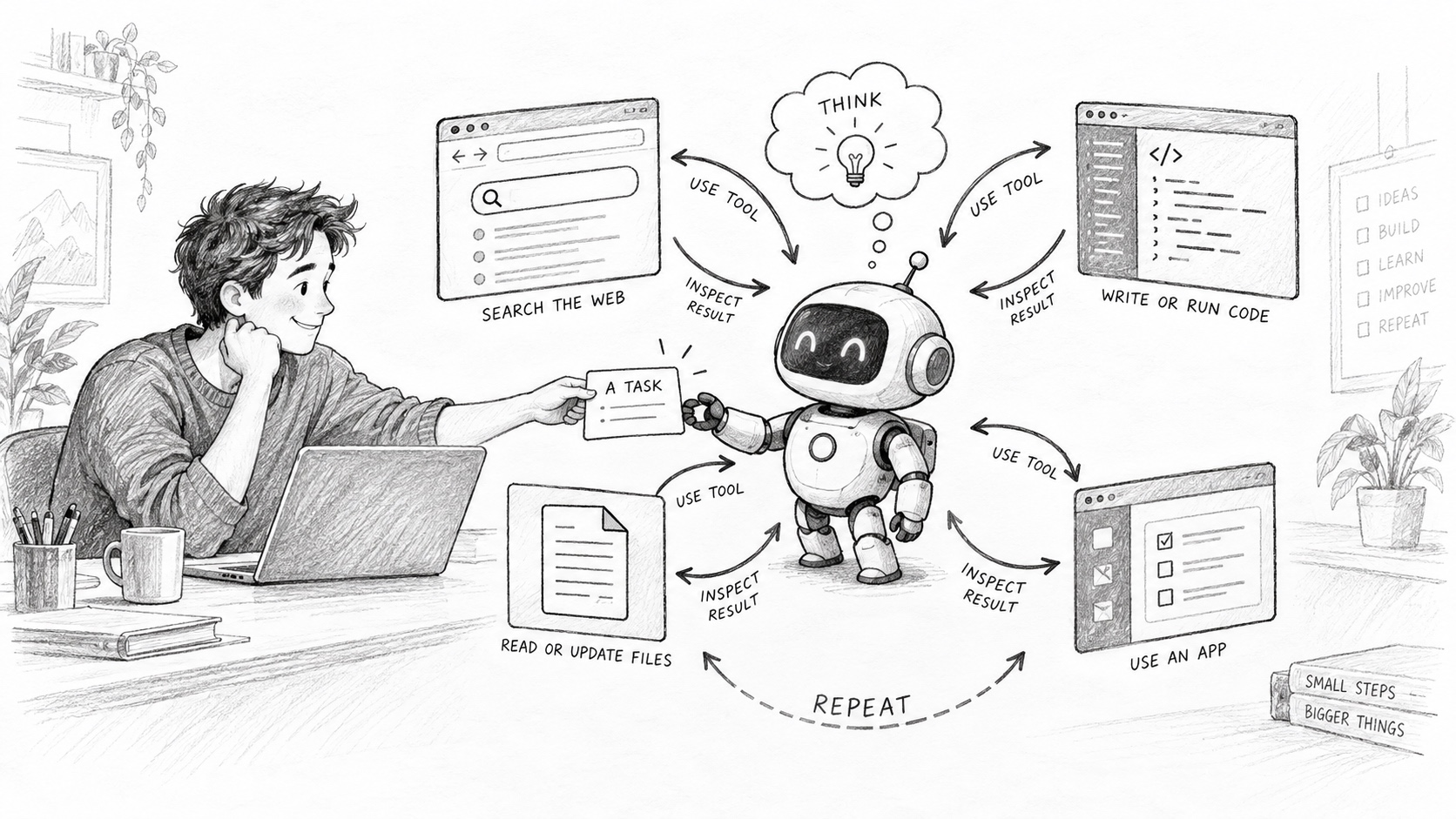
One topic that is becoming more and more prominent is AI agents. No matter where you look, even on traditional news channels, the word “agent” seems to be popping up. And that is with good reason: AI agents are basically the natural next step in our current AI revolution.
It all really started with the introduction of ChatGPT in November 2022: a chatbot that would somewhat intelligently answer whatever questions you gave it. Initially, answer quality was very mixed, with results fluctuating between pure garbage and fairly good. What followed is probably one of the most impressive improvement curves of recent times. Within less than four years, we saw this technology move from an impressive toy to systems capable of writing software, doing research and even contributing to highly complex mathematical problems.
But intelligence is only one part of what changed.
What was released in 2022 was, for the most part, a chatbot. You wrote something, it wrote something back.
By now, we’ve evolved quite a bit.
Most importantly, we’ve given those chatbots the ability to use tools.
MCP, if you’ve heard of it, is basically a standard for exposing tools to agents.
This gives us a kind of loop:
Human gives AI some task
→ AI thinks about what to do
→ AI uses a tool
→ AI looks at the result
→ repeat until the task is complete
Suddenly, the chatbot cannot only write text, but also search the web, run code, read files or interact with existing apps and websites.
That is basically what we now call an AI agent: an AI system that can use tools and independently work towards completing a task.
You could simplify it to:
AI model + tools + a loop = agent
The important difference is really quite simple:
A chatbot can tell you how to do something.
An agent can actually go and do it.
Now, autonomy is really more of a spectrum: some agents only act after you give them a task, while others can run continuously and decide when work needs to be done. Agents can also delegate work to other agents, creating multi-agent systems — though for most tasks, one capable agent is probably simpler and perfectly sufficient.
I don’t know when we’ll reach agents that can genuinely operate on their own for long periods without us having to tell them what to do. But we also don’t really need to wait for that. Agents can already do useful work today.
So the question seems to be moving from:
“What can I ask AI?”
to:
“What work can I give to AI?”
And I think learning how to answer that question could become quite an economic advantage.